video

In early June, Sarah Lewthwaite delivered the Oxford Annual Disability Lecture (“Digital Accessibility at the Crossroads: Infrastructure, AI, and the Future We Build“) at an online and in person event at Oxford’s Life and Mind Building.

The lecture is now available as a video (including BSL, captions), podcast, and transcript with alternative formats are available via https://podcasts.ox.ac.uk/2026-disability-lecture
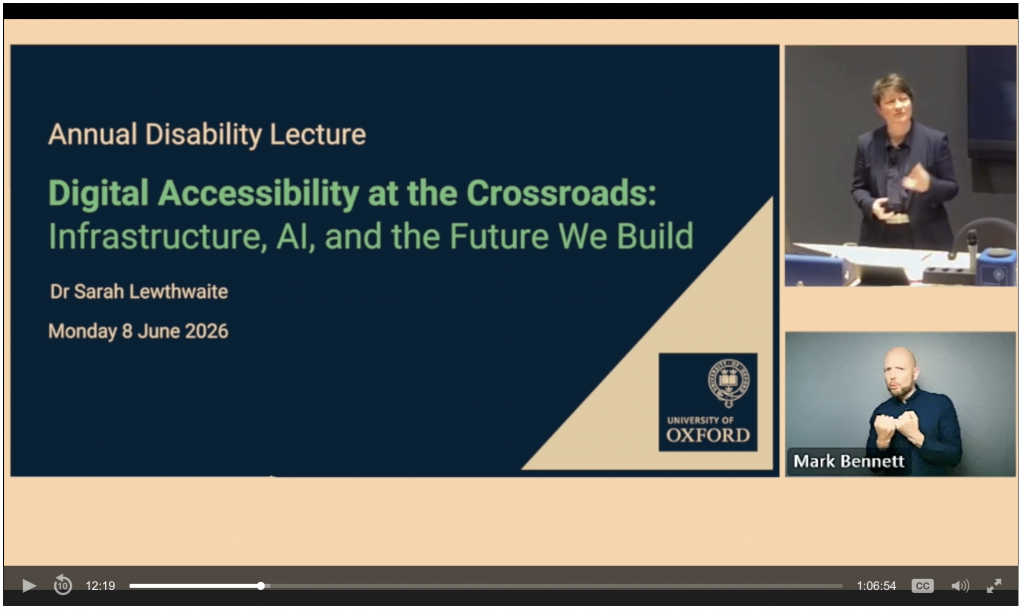
Screenshot of Sarah's presentation, with the title slide, and Sarah gesturing and a BSL interpreter, Mark Bennett, signing.

Sarah’s talk considered that state of digital accessibility in view of new laws committing to accessibility as a foundation for digital life, and recognising that accessibility must be built into systems and infrastructure from the start. Artificial intelligence, by contrast, does not have the same settled direction. AI has the potential to build and scale accessibility, but it also risks reinforcing patterns of exclusion and creating new ones if left unchecked. 

Hosted by the Disability and Neurodivergence Advisory Group and the Equality and Diversity Unit, Sarah explored contemporary answers to long-standing questions about who technology serves. How do we ensure our universities, workplaces and wider digital society are accessible to all? How do we make sure that lived experience of disability is recognised and valued in the design and development process? These questions are not new, but the scale, speed, and nature of AI demands new answers. Sarah’s talk will draw on current research into digital accessibility, accessibility education and AI. She will consider key issues, conceptual tools, and research-led routes for positive action.
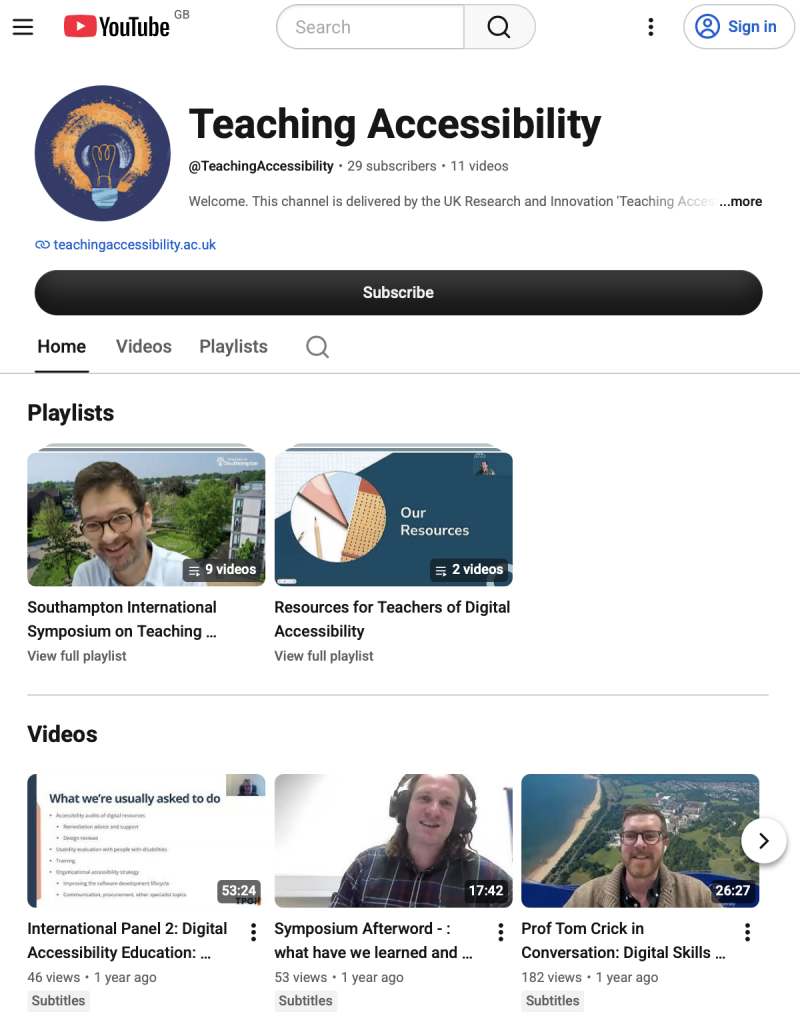
We’ve launched a new Teaching Accessibility YouTube Channel. The Channel already includes all video contributions from our 2025 Southampton International Symposium on Teaching Accessibility. You can browse these individually, or follow the flow of the scheduled conference through the SISTA2025 playlist. We also have a resources playlist, and great video from Kate Sonka’s visit to Southampton, introducing the work of Teach Access in November 2024. There is more to come, so please subscribe to the Channel for further updates.

Captioned video is now available from Sarah Lewthwaite’s talk ‘Teaching accessibility: 10 messages from research’ at Inclusive Design 24 on 10th October 2019. This talk introduces evidence-based principles from educational research that can be applied in the teaching and learning of accessibility.

Sarah Lewthwaite presentation to Inclusive Design 24: 10 October 2019

Abstract: Teaching accessibility: 10 messages from research

This is a talk for everyone who talks about accessibility. People need to know more about accessibility, but it can be challenging to teach. It requires a unique mix of conceptual understanding, technical skill and procedural knowledge. In this talk I will introduce 10 teaching tools – principles and strategies for effective pedagogy – that are drawn from more than a decade of empirical academic research in education. Join me to expand your educational repertoire, so you can more effectively share accessibility with colleagues, teams and wider audiences.

Other talks from this wide-ranging and dynamic conference are available via ID24’s YouTube channel.

Captioned video is now available from Dr Sarah Lewthwaite’s talk ‘Learning and Teaching Accessibility’ at the 29th London Accessibility Meetup, on the 23rd of September, 2019.

Sarah Lewthwaite presentation to London Accessibility MeetUp, 23 September 2019

This presentation was made alongside Dr Abi James (AbilityNet) earlier talk ‘Digital Accessibility Regulatory Landscape – are you ready?’, on the day new regulations came into force in the UK and Europe.

Abstract: Learning and teaching accessibility (Dr Sarah Lewthwaite, University of Southampton)

Digital technologies have revolutionised daily life, yet the capacity for accessible tools and services has not kept pace with demand, resulting in the ongoing exclusion of disabled people and older people. Despite the social cost, new legislation and a trajectory of growing demand for accessible digital services, there is still a lack of detailed understanding of how accessibility can be effectively taught, learned and scaled.

This talk introduces new research into the pedagogy of accessibility – reporting on a systematic literature review of published work in this field. Together we will consider what is known about the teaching and learning of digital accessibility, what makes it distinct and challenging, and how we – as practitioners, trainers, educators, advocates and experts – can work together to build upon this knowledge, to cascade our skills and understanding more effectively to co-workers, colleagues, clients and others.

Sarah’s talk begins at 1hr 15 minutes.