Digital Accessibility

Our new report examines critical perspectives on the impact of artificial intelligence on digital accessibility professional practice and skills development. Critical Approaches to AI and Accessibility Capacity Building was published on 1 June 2026.

The report documents insights from the second in a series of collaborative workshops on AI and Accessibility Skills, run in partnership with Jisc, and held online on 27 February 2026. It follows and builds on our first report which summarised the first workshop at Jisc London in June 2025.

The second workshop brought together 48 participants from higher education, industry, policy, governance and research organisations. The report explores insights and strategic priorities from discussions prompted by our expert speakers, who examined how AI and digital accessibility practices are shaping disability futures, fundamental shifts in accessibility skills, and the role of d/Deaf-led community engagement in development and governance. Preliminary policy/practice recommendations address human-centred AI, structural bias, and professional competencies, education and accountability.

The workshop series forms part of the UKRI-funded Teaching Accessibility in the Digital Skill Set project, with plans to run further workshops through to 2027.

Please cite the report as:
Lewthwaite, S. and Coverdale, A. (2026) Critical Approaches to AI and Accessibility Capacity Building: Insights from the Second AI and Accessibility Skills Workshop [white paper]. University of Southampton. UK. https://doi.org/10.5258/SOTON/PP0180
Our new report examines the impact of artificial intelligence on digital accessibility professional practice and skills development.

AI and Accessibility Skills: Building the Accessibility Professional of the Future was published on 5 February 2026, documenting insights from a collaborative workshop held in partnership with Jisc in 2025. The workshop brought together 40 accessibility leaders, educators, researchers and practitioners from higher education, industry, policy and governance organisations across the UK.

The report explores how AI-enabled tools are reshaping accessibility workflows in areas including design, coding, captioning and testing, whilst raising critical questions about reliability, potential deskilling, and the displacement of human engagement with disabled user communities. Expert speakers examined the distinctively human skills that AI cannot replicate, AI’s limitations in generating accessible code, and ethical concerns regarding BSL avatar technologies and community co-design.

The workshop forms part of the UKRI-funded Teaching Accessibility in the Digital Skill Set project, with subsequent workshops planned across 2025-2027 to sustain sector-wide dialogue as AI’s role in accessibility practice evolves.

We’ve launched a new mailing list for accessibility educators and practitioners, providing a group space for community-driven knowledge exchange on teaching digital accessibility.

As AI tools increasingly mediate professional practice, we wanted to create a space that emphasises the importance of collective expertise, community knowledge sharing and mutual support. The Teaching Accessibility mailing list, hosted on JiscMail, is free and open to all, and direct to your inbox, with no advertisements or corporate ownership.

Whether you’re teaching accessibility in higher education or colleges, delivering professional training, developing curricula, or supporting workplace learning, this group is what we make it. Share pedagogical approaches, ask questions, discuss teaching challenges, exchange resources, and build connections across institutions and sectors. The community will be what you make it and what you need it to be.

Join us: https://www.jiscmail.ac.uk/cgi-bin/wa-jisc.exe?A0=TEACHING-ACCESSIBILITY

Later this month, we are hosting an event with Jisc in London.

AI and accessibility skills: building the accessibility professional of the future’ is a collaborative workshop exploring the future of accessibility work and skills development in the context of Artificial Intelligence, on Friday 27th June, 12 noon-16.30, at Jisc London.  The event is free to attend, with lunch included. For more details and to register, please visit the Jisc Registration page. For those unable to attend, future events are planned across the UK. We will be reporting from the workshop – so watch this space for updates, or get in touch directly.

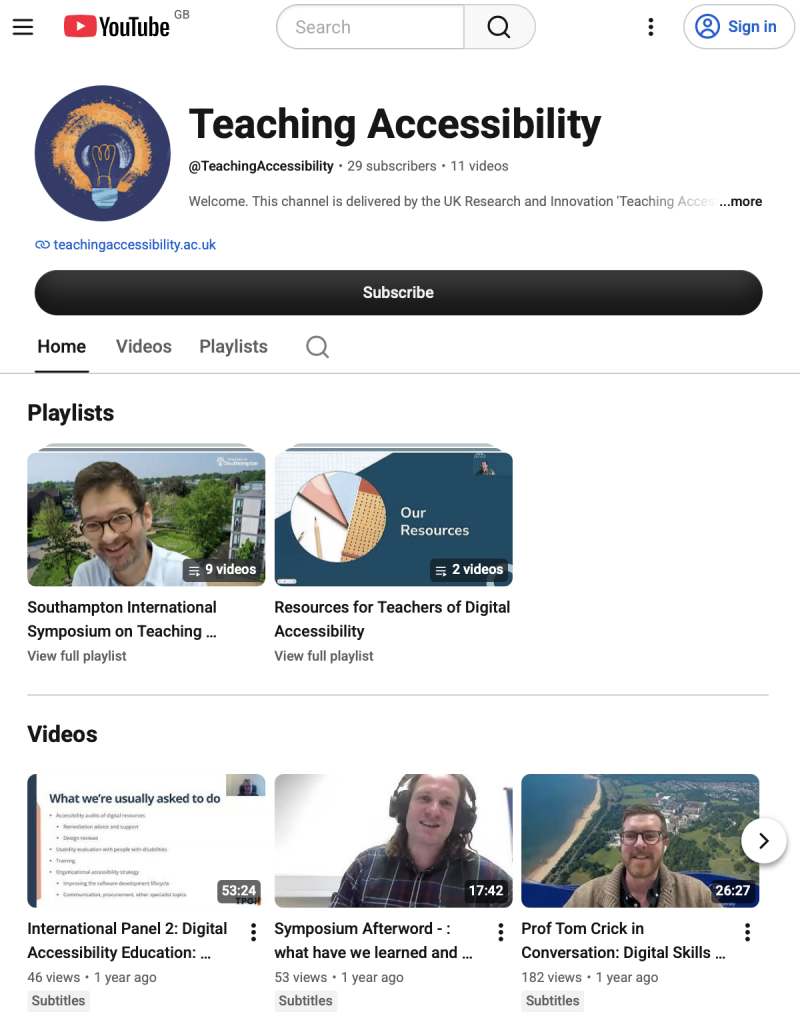
We’ve launched a new Teaching Accessibility YouTube Channel. The Channel already includes all video contributions from our 2025 Southampton International Symposium on Teaching Accessibility. You can browse these individually, or follow the flow of the scheduled conference through the SISTA2025 playlist. We also have a resources playlist, and great video from Kate Sonka’s visit to Southampton, introducing the work of Teach Access in November 2024. There is more to come, so please subscribe to the Channel for further updates.

Sarah Horton (our Visiting Fellow) and David Sloan have recently published the landmark book ‘What Every Engineer Should Know About Digital Accessibility‘ Synthesised from decades of experience working at the cutting-edge of digital accessibility practice, Horton and Sloan distil the key principles, methodologies and approaches that every engineer needs in their tool kit. What Every Engineer Should Know About Accessibility delivers a perfect balance of conceptual and practical content, for a deep dive, or for reference. It also brings in expert voices from the international vanguard of accessibility – advocates, academics and industry leaders. The result is a range of perspectives that highlight the innovation and richness that is at the heart of engineering for accessibility; and the real-world harm that can and does result from digital exclusion. For a product, service, platform or tool to be truly excellent, it must be excellent for everyone. In this ground-breaking book, Horton and Sloan show how this excellence can be engineered for all, with disabled people at the centre.

We heartily recommend this book – and there is a 20% discount available [code: EFLY03] on the £29.99 cover price available from Routledge at time of writing. Congratulations to Sarah H and David on this excellent work!