July 2026

In early June, Sarah Lewthwaite delivered the Oxford Annual Disability Lecture (“Digital Accessibility at the Crossroads: Infrastructure, AI, and the Future We Build“) at an online and in person event at Oxford’s Life and Mind Building.

The lecture is now available as a video (including BSL, captions), podcast, and transcript with alternative formats are available via https://podcasts.ox.ac.uk/2026-disability-lecture
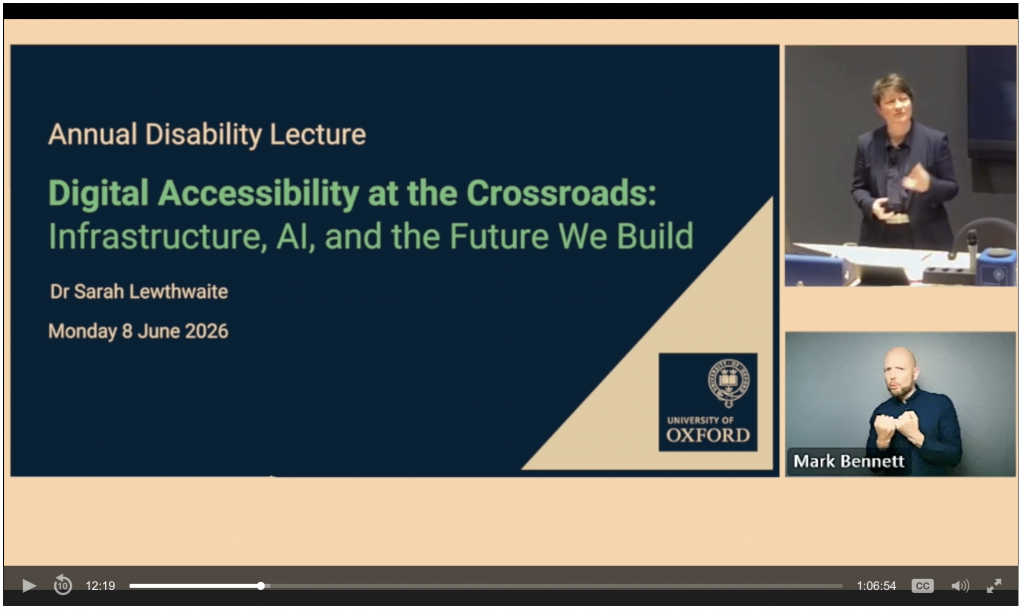
Screenshot of Sarah's presentation, with the title slide, and Sarah gesturing and a BSL interpreter, Mark Bennett, signing.

Sarah’s talk considered that state of digital accessibility in view of new laws committing to accessibility as a foundation for digital life, and recognising that accessibility must be built into systems and infrastructure from the start. Artificial intelligence, by contrast, does not have the same settled direction. AI has the potential to build and scale accessibility, but it also risks reinforcing patterns of exclusion and creating new ones if left unchecked. 

Hosted by the Disability and Neurodivergence Advisory Group and the Equality and Diversity Unit, Sarah explored contemporary answers to long-standing questions about who technology serves. How do we ensure our universities, workplaces and wider digital society are accessible to all? How do we make sure that lived experience of disability is recognised and valued in the design and development process? These questions are not new, but the scale, speed, and nature of AI demands new answers. Sarah’s talk will draw on current research into digital accessibility, accessibility education and AI. She will consider key issues, conceptual tools, and research-led routes for positive action.

Our new report examines critical perspectives on the impact of artificial intelligence on digital accessibility professional practice and skills development. Critical Approaches to AI and Accessibility Capacity Building was published on 1 June 2026.

The report documents insights from the second in a series of collaborative workshops on AI and Accessibility Skills, run in partnership with Jisc, and held online on 27 February 2026. It follows and builds on our first report which summarised the first workshop at Jisc London in June 2025.

The second workshop brought together 48 participants from higher education, industry, policy, governance and research organisations. The report explores insights and strategic priorities from discussions prompted by our expert speakers, who examined how AI and digital accessibility practices are shaping disability futures, fundamental shifts in accessibility skills, and the role of d/Deaf-led community engagement in development and governance. Preliminary policy/practice recommendations address human-centred AI, structural bias, and professional competencies, education and accountability.

The workshop series forms part of the UKRI-funded Teaching Accessibility in the Digital Skill Set project, with plans to run further workshops through to 2027.

Please cite the report as:
Lewthwaite, S. and Coverdale, A. (2026) Critical Approaches to AI and Accessibility Capacity Building: Insights from the Second AI and Accessibility Skills Workshop [white paper]. University of Southampton. UK. https://doi.org/10.5258/SOTON/PP0180